Overview
The Chattanooga Police Department Drone First Responder Program provides critical, real-time information about incidents, helping officers make faster, more informed decisions, de-escalate uncertain situations, and improve safety for officers, community members, and suspects.
The program is a tele-operated drone platform capable of answering calls for service, obtaining real-time information, and is utilized as an officer multiplier. It consists of two prepositioned unmanned aircraft systems (UAS) located at CFD stations four (2181 Curtis St) and nine (3250 8th Ave). These DFR dock locations were selected based on crime data, determining the areas in which violent crime most frequently occurred. Each DFR dock is mounted to a trailer so they can be relocated as crime analysis dictates a shift in violent crime. CPD has authorization from the FAA to operate these platforms up to a 2-mile radius from the docks.
When a 911 or police-generated call for service occurs, the UAS may be launched by a trained operator located in the CPD Real Time Intelligence Center (RTIC) and fly to the scene of the call. Once on scene, the drone transmits live footage to responding officers, operators, and incident commanders. If neighborhood policing officers are still needed to respond, the UAS will stay over the scene until the call is stabilized, at which time the UAS will return to the launch/landing location.
The DFR Program will Primarily:
- Improve police response times.
- Assist with locating criminal suspects and missing people.
- Search areas that can be risky for officers to enter.
- Assist the Chattanooga Fire Department (CFD) with community outreach and special events.
- Operate in coordination with CPD’s operations guided by the Certificate of Authorization (COA) issued by the Federal Aviation Administration (FAA).
The DFR Program will NOT:
- Routinely patrol an area or conduct random surveillance.
- Violate reasonable expectations of privacy.
- Replace police officers.
- Make its own decisions.
- Deploy to all calls or in weather conditions that would likely cause loss of pilot control of the UAS.
Privacy
CPD’s SOP-28, Unmanned Aircraft System, prohibits the department and its officers from using drones for general surveillance, harassing individuals or groups, or conducting business not law enforcement-generated or affiliated. Every deployment is governed by department policy, publicly reported, and never used for federal surveillance.
Data obtained by the UAS shall be retained in accordance with CPD OPS-63, Digital Recording Systems, and SOP-22, Digital Evidence.
DFR Activity Dashboard
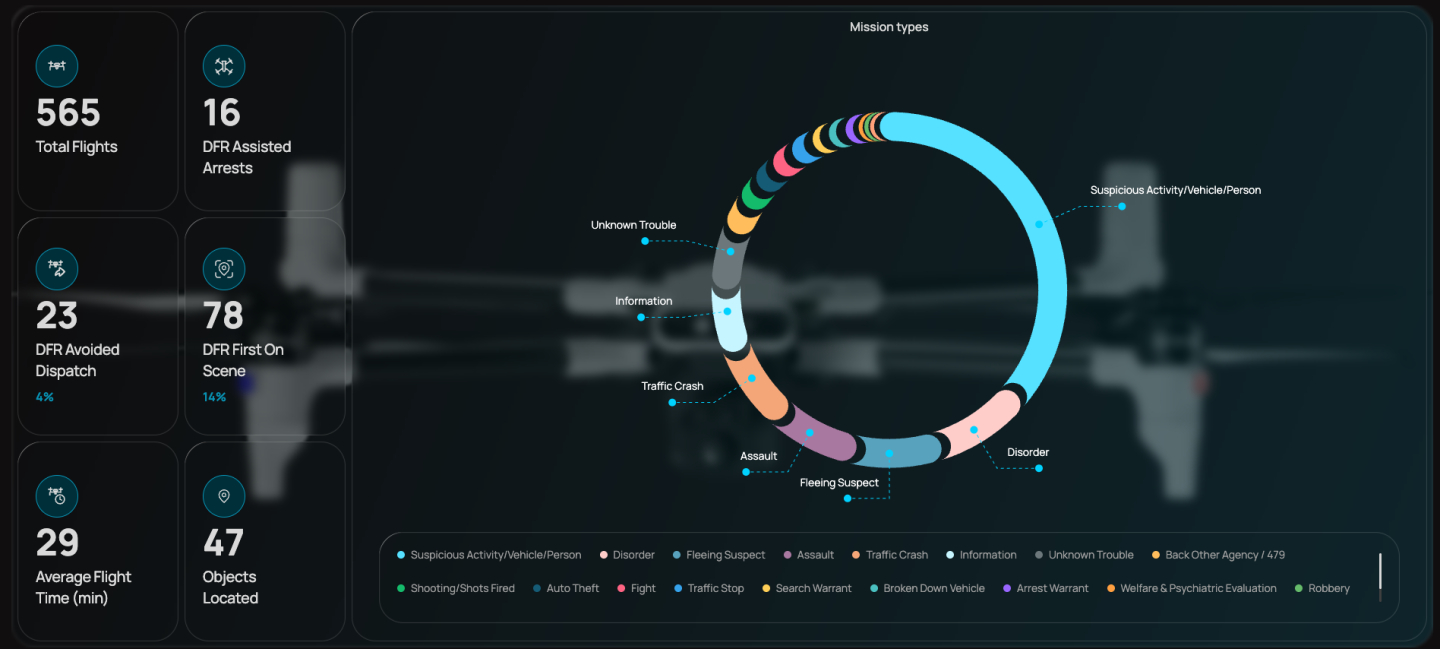
This dashboard provides information on the CPD’s DFR program. It provides flight maps and duration, call type, and date/time.
Image
Department UAS History
CPD launched its UAS/Drone Unit in 2022 with four operators and nine drones. In 2026, there are 13 certified drone operators across Neighborhood Policing, RTIC, Traffic, and Tactical Operations, manning 21 drone platforms. These drones are smaller in size than the drones used in the DFR program and are not pre-positioned; they can be launched by a trained officer on the ground from nearly any incident location.
During its first year, the CPD Drone Unit responded to 30 calls. In 2025, they responded to more than 200 calls for service. Crash investigations, SWAT calls, robberies, and special events are just a few examples of when these drones may be used.
These drones are manufactured by BRINC, DJI, and Autel, and, like the UAS used in the DFR program, are neither weaponized nor equipped with facial recognition technology.
When did the DFR program start?
CPD began utilizing drone technology in July, 2022, with Drone as First Responder (DFR) always being a program to transition to. It was not until 2024 that the theory of DFR became a reality for public service agencies. CPD was able to utilize state grant funding for the purchase of two teleoperational drone platforms that are operated from our Real Time Intelligence Center (RTIC). CPD’s DFR operations began in February 2026, where it has been successful in aiding our community by providing faster response times to calls for service as well as delivering important information to the officers arriving on scene.
What type of UAS is CPD using in its DFR program?
CPD is using two Brinc Responder drones with a dock for the DFR program. Brinc drones are NDAA-compliant.
We also have seven Brinc drones and eleven additional drones from other manufacturers that are not part of the DFR program. Under current TCA (4-56-112), which took effect on July 1, 2023, law enforcement agencies in Tennessee are prohibited from procuring any drones listed under the federal NDAA Section 889 ban, including those manufactured by DJI and Autel. Prior to July 1, 2023, CPD already had four DJI and seven Autel platforms in its fleet.
Where are the photos and videos captured by the DFR stored, and who has access to them?
Any video and photo evidence taken during a DFR deployment is stored in the same system and manner as police body-worn camera (BWC) and police in-car camera system evidence. DFR video is treated as evidence, and the retention periods are the same as the current policy for BWC and in-car camera evidence.
Generally, UAS photos and videos are considered part of the investigative record and are not available to the public under the Tennessee Open Records Act or Freedom of Information Act (FOIA) until the case has been fully adjudicated.
How is the privacy of community members protected?
What type of calls does the DFR program respond to?
DFR program is used for, but not limited to, searching for missing persons, situational awareness to assist incident commanders with understanding the scope of a critical incident scene, collecting imagery of crime scenes and traffic crash scenes, searching for a fugitive, assisting the fire department, community outreach, providing a visual perspective for traffic/crowd control and safety, support disaster response, and during any operation where preservation of life is a priority. We do NOT proactively patrol, and we do NOT use drones for random surveillance. This policy helps protect the privacy of all Chattanooga community members and visitors.
What criteria did CPD use when choosing the launch sites?
Similar to the placement of the CPD public safety cameras, we took a data-informed approach to determining the launch locations. The CPD crime analysts studied crime data, calls for service volume, and call types. These locations are more densely populated with a higher percentage of crime, including violent crime.
Why does CPD use drones instead of helicopters?
Four main reasons: safety, cost, quicker deployment, and drones do more.
A CPD officer is far less likely to (or is less likely to) be hurt or killed should a drone fail and crash. Drones are cheaper to purchase and maintain. It also costs less to obtain drone certification than to train a pilot. Designated officers across the city have drones stored in their vehicles & can easily launch when needed. Drones can be used to take photos and videos at scenes, and multiple drones can be used at the same time.
Are the drones noisy?
CPD’s DFR flies at a max speed of 38 mph and between 200 to 400 feet above the ground. At that height, the noise is very minimal - a faint buzzing. Most people don’t even hear it.
What identifiers are there showing that the drones in the DFR program are police drones?
CPD’s DFR Drones have a black and white color scheme similar to some of our police vehicles. They are also equipped with red and blue LED lights that flash to make people aware it is a police drone, as well as being utilized as an anti-collision beacon for other aircraft.
What type of training is required for CPD DFR program pilots?
I fly drones and am interested in joining the CPD DFR program. How do I apply?
Currently, policy dictates that all drone operators are CPD officers. Becoming a CPD UAS pilot is just one path an officer can take when they become a CPD officer. If you're interested in becoming a CPD officer, apply here.